
Criminal Court Records in Houston County
A criminal court record is the file maintained by the court once a criminal matter is opened. In Houston County, felony records belong primarily to Superior Court, while misdemeanor, traffic misdemeanor, and some ordinance or Game and Fish matters are handled in State Court. Magistrate Court may appear for preliminary criminal, pretrial, warrant, and related matters. For the charge-only path after an arrest, use Arrest Records & Charges; for the complete case history and disposition, use the criminal court record.
The county's State Court misdemeanor source confirms that State Court handles misdemeanor cases and reports required misdemeanor dispositions to GCIC.
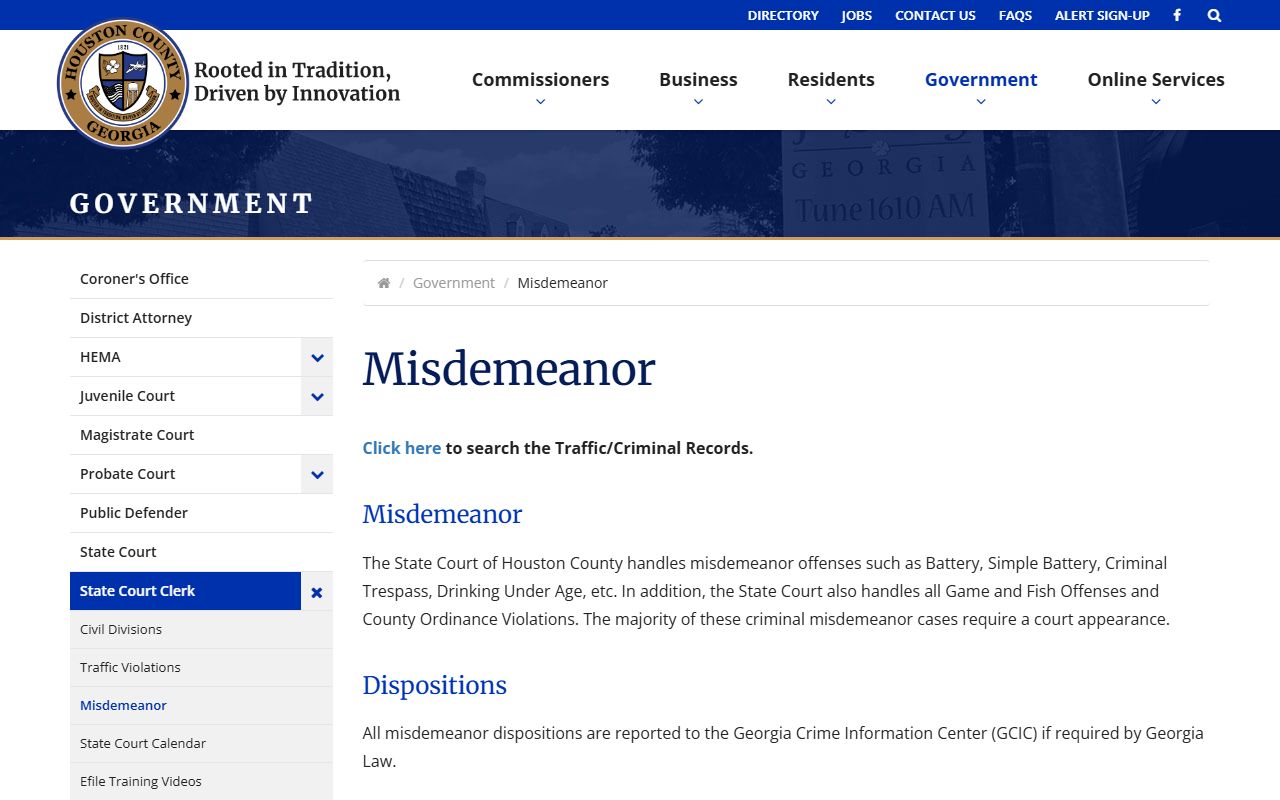
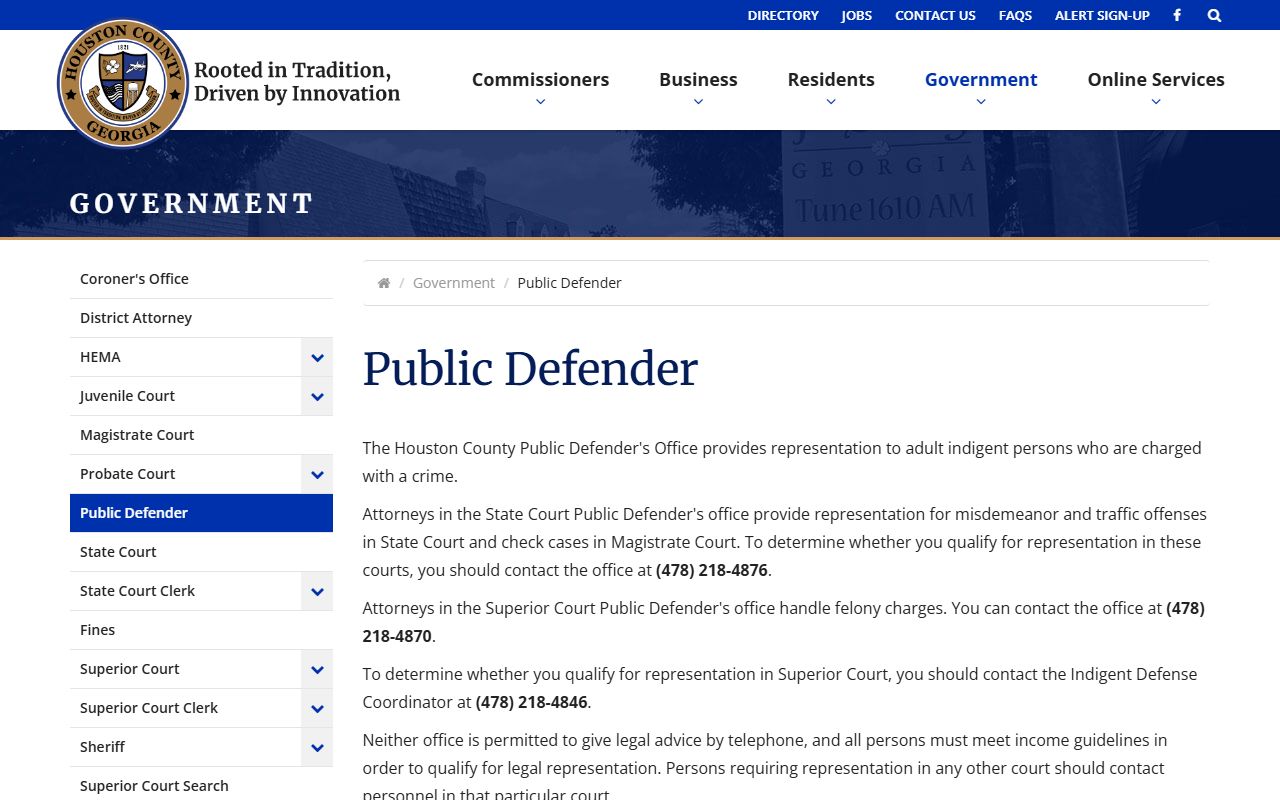
Superior Court is the general-jurisdiction trial court and has exclusive felony trial jurisdiction under the Georgia Constitution language quoted by the county. State Court is a limited-jurisdiction court for misdemeanors, traffic violations, and certain civil matters. The Public Defender page also reflects this split: State Court attorneys represent misdemeanor and traffic offenses, while Superior Court attorneys handle felony charges.
How to Search Houston County Criminal Court Records
Use the Benchmark public case search for Superior, State, and Magistrate case lookup. Criminal searches can use name, Soundex name, case number, warrant number, arresting case number, SAO case number, date ranges, court type, division, and Statutes / Charges. Relevant court types include Superior Criminal, State Criminal, State Traffic, Magistrate Criminal, and Magistrate Pre Trial.
- Open Benchmark and start with case number if known, or defendant name if not.
- Use Soundex Name if the spelling is uncertain or the person may appear under an alias.
- Filter to Superior Criminal for felony matters, State Criminal or State Traffic for misdemeanor or traffic cases, and Magistrate Criminal or Magistrate Pre Trial for preliminary matters.
- Use Warrant Number, Arresting Case Number, SAO Case Number, or Statutes / Charges when those identifiers are known.
- Read the docket and disposition before treating a charge as an outcome.
- Call Superior Court Clerk criminal division at (478) 218-4730 or State Court Clerk at (478) 218-4970 for certified copies or unavailable records.
Statewide criminal-history restriction issues are separate from local case lookup. The GBI record-restriction process and O.C.G.A. 35-3-37 control many eligible restriction requests. The Sheriff's Records Division handles Houston County sheriff-originating copies, open-records processing, and record restriction requests, but post-July 1, 2013 arrests generally start with the prosecutor rather than the arresting agency application process.
Stages of a Criminal Case
A criminal court file grows as the case moves from charge filing to hearing activity and final outcome. Arrest and booking may happen first, but the court file is built around filed allegations and court events. Warrants, bond information, accusations, indictments, arraignment, motions, pleas, trial events, disposition, sentencing, probation, fines, and copy-certified judgments can all become relevant depending on the case.
Case flow: Charges Filed › Arraignment › Pretrial / Motions › Plea or Trial › Disposition › Sentencing
| Stage | What Happens |
|---|---|
| Charges Filed | The prosecutor or grand jury path places formal allegations into the court system. |
| Arraignment | The defendant is informed of the charge and a plea is entered or scheduled. |
| Pretrial / Motions | The docket may show motions, hearings, continuances, bond issues, or discovery-related activity. |
| Plea or Trial | The case resolves by plea, trial verdict, dismissal, nolle prosequi, or other disposition. |
| Sentencing | The record may show jail, probation, fines, conditions, restitution, or other sentencing terms. |
What a Houston County Criminal Court Record Shows
Benchmark's field inventory confirms that criminal court records can be searched and interpreted through case numbers, court types, division codes, party fields, dates, case types, charge/statute data, arresting agency case numbers, SAO case numbers, warrant numbers, and citation identifiers. The full file may contain more than a public search result, and restricted or redacted material may be withheld.
| Field | What It Shows |
|---|---|
| Case Number | The court's unique identifier, with Benchmark hinting at a year + case type + six-digit format. |
| Defendant | The accused party and possible alias search connections. |
| Court / Division | Superior Criminal, State Criminal, State Traffic, Magistrate Criminal, Magistrate Pre Trial, or related division codes. |
| Charges | The alleged offenses and statutes, which may change before final disposition. |
| Plea | The defendant's formal response, such as guilty, not guilty, or other plea event where public. |
| Disposition | The charge or case outcome, including conviction, dismissal, acquittal, nolle prosequi, or other closure. |
| Sentence | Jail, probation, fines, conditions, or other penalties if a sentence was entered and public. |
Charges vs. Convictions
Being charged is not the same as being convicted. A criminal case record may show charges that were amended, reduced, dropped, dismissed, resolved by plea, or ended in acquittal. For that reason, read the disposition and sentence fields before describing an outcome. For custody status, use Inmate Records; for warrant confirmation, use Warrant Records; for all case categories, use Court Records.
| Charge | Conviction | |
|---|---|---|
| Stage | Allegation filed in court | Outcome after plea, verdict, or adjudication |
| Proof | Not a final finding of guilt | Reflects guilt by plea or verdict unless later changed |
| Public Record | Often public unless sealed or restricted | Often public unless sealed, restricted, or legally withheld |
Reading Dispositions and Sentences
Disposition is the result of the charge or case. It may be shown as guilty, not guilty, dismissed, nolle prosequi, acquitted, transferred, bound over, closed, or another local entry. Sentencing is separate and may include incarceration, probation, fines, court costs, restitution, treatment, or other conditions. State Court's misdemeanor page is important because it says all misdemeanor dispositions are reported to GCIC when required by Georgia law.
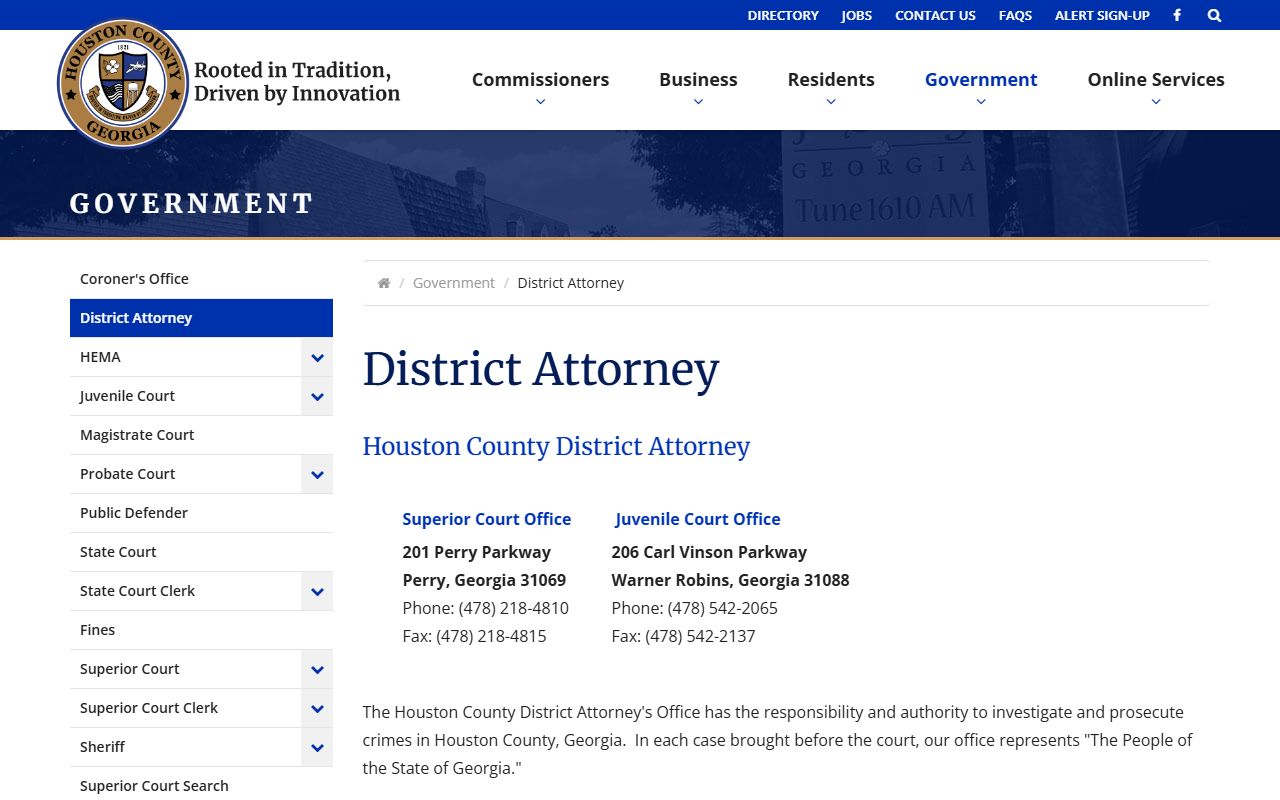
The District Attorney source names Eric Z. Edwards and describes the office's authority to investigate and prosecute crimes for the People of the State of Georgia.
The Public Defender source separates State Court misdemeanor and traffic representation from Superior Court felony representation.
Sealed vs. Expunged Records
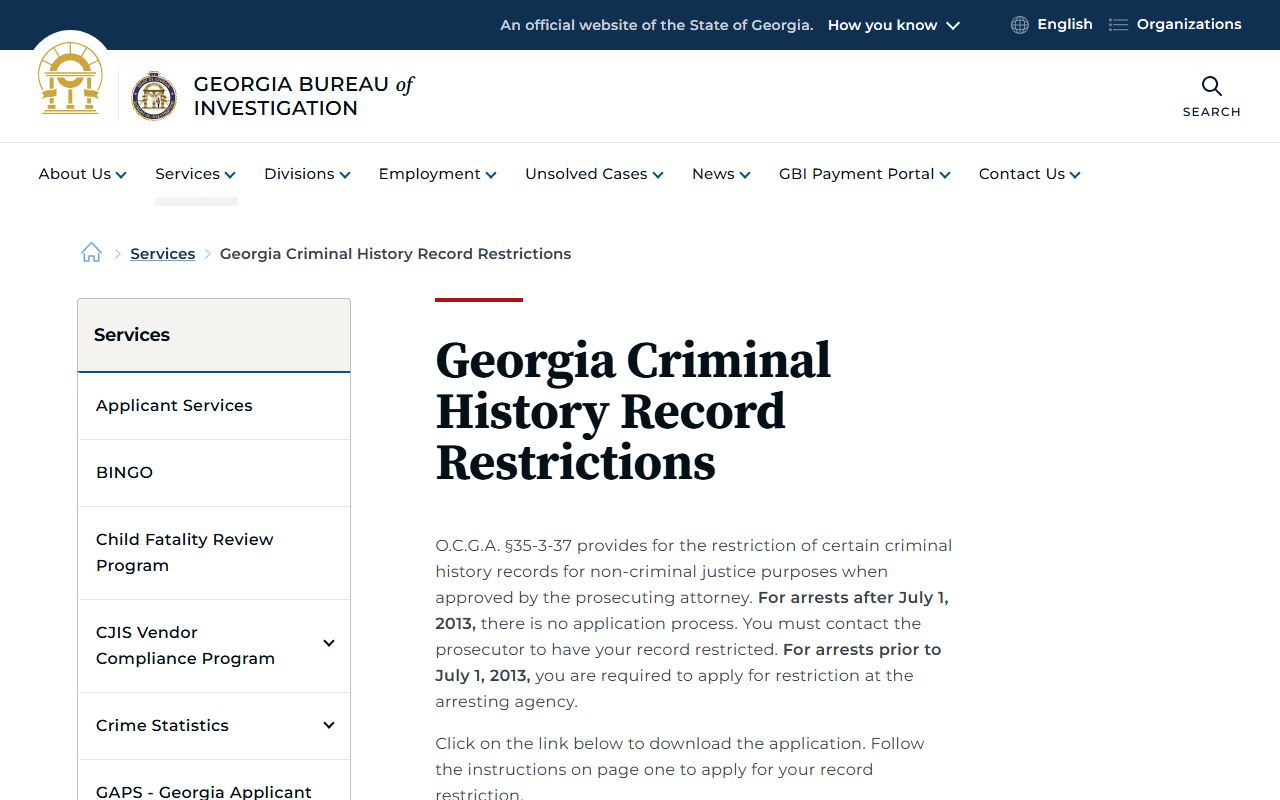
Georgia commonly uses record restriction rather than the older broad term expungement. Under O.C.G.A. 35-3-37, eligible arrests and some outcomes can be restricted for non-criminal-justice purposes. The process depends on arrest date and result. For arrests after July 1, 2013, the GBI says the person contacts the prosecutor; for earlier arrests, the person applies through the arresting agency. Houston County Sheriff's Warrants & Records lists a $25 Sheriff's Office restriction fee and a possible $25 GCIC fee if approved by the courts.
| Sealed | Restricted / Expungement-Type | |
|---|---|---|
| Visibility | Hidden from general public by law or court order | Limited for non-criminal-justice purposes if eligible and approved |
| Law Enforcement | May retain access under legal rules | Criminal-justice access may remain depending on Georgia law |
| Eligibility | Depends on the court, record type, and sealing order | Controlled by O.C.G.A. 35-3-37, prosecutor, agency, and court steps |
The GBI record restriction source explains Georgia's restriction process.
The statute text is also available from the O.C.G.A. 35-3-37 source.
Public Access to Criminal Court Records
Georgia public access starts with the Georgia Open Records Act and O.C.G.A. 50-18-71 for inspection and copying, but court records also depend on court rules, sealing orders, statutory limits, and clerk procedures. Uniform Superior Court Rule 21 supports presumptive access to Superior Court records unless restricted by law or the sealing process. Criminal court records can be public while still redacting Social Security numbers, financial account numbers, victim-sensitive information, protected addresses, and other legally protected data.
Key Statutes:
O.C.G.A. 50-18-71 - Public records are generally open for inspection and copying unless a law or court order restricts them.
O.C.G.A. 35-3-37 - Georgia's criminal-history restriction statute controls eligible restrictions and related procedures.
Federal criminal cases are not Houston County criminal court records. If a case is federally prosecuted, federal records use U.S. District Court and PACER channels. The U.S. Attorney Middle District of Georgia source is relevant for federal prosecutions in the district, not ordinary county State Court or Superior Court files.
Background Check Considerations
Casual case lookup is different from a legally compliant employment, housing, credit, insurance, or tenant background check. A court search may show a charge, but it may not show identity verification, later restriction, complete statewide history, or federal and out-of-state records. Use court records as source records and verify with the originating office before making legal, employment, or screening decisions.
Important: This website is not a consumer reporting agency and may not be used for FCRA-regulated decisions.
Restricted Criminal Court Records in Houston County
Juvenile criminal-type matters are restricted more heavily than adult records. Houston County Juvenile Court covers dependency, delinquency, unruly conduct, and traffic involving children under 17, and O.C.G.A. 15-11-701 allows juvenile files and records to be sealed. Adult criminal records may also be sealed, restricted, redacted, or partially withheld when required by law or court order. If a public search omits a record that should exist, contact the clerk or prosecutor rather than assuming the case never existed.